
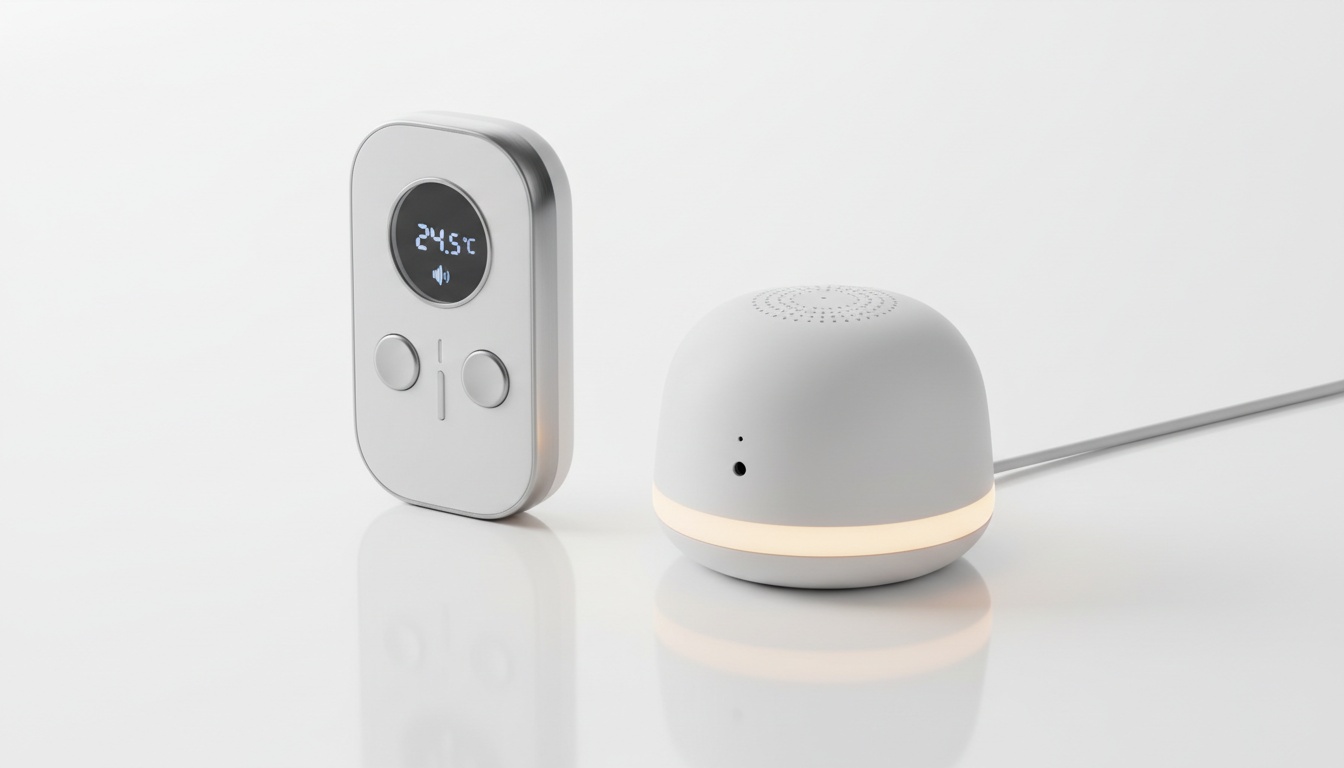
1. What Is an Audio Baby Monitor and How Do They Work?
A digital audio monitor consists of two main components: a baby unit that stays in the nursery and a parent unit you carry around the house. Unlike smartphone apps or video baby monitors vs audio that rely on your home network, many quality audio monitors use DECT technology—the same secure digital system that powers modern cordless phones.
How DECT Technology Works
DECT (Digital Enhanced Cordless Telecommunications) creates a closed system between your two devices. The baby unit picks up sounds in the nursery and transmits them directly to your parent unit using encrypted digital signals. No network connection required. No cloud storage involved. No vulnerability to the hacking attempts that plague network-enabled monitors.
According to testing data, transmission ranges vary significantly between models and testing conditions, with performance depending on factors like wall thickness and interference. Open-field ranges can extend much further than indoor ranges, though actual performance varies by model and environment.
DECT vs Network Technology Explained
DECT uses dedicated frequencies separate from home networks, preventing interference from routers and microwaves. Network-enabled monitors connect through your router, which means a network outage leaves you monitoring-free—and creates a potential entry point for hackers, as demonstrated by various security incidents involving network-connected cameras.
They also compete for bandwidth with every other connected device in your home—not ideal when you're trying to hear if your baby is stirring at 2 AM.
2. Audio Monitors vs Video Monitors: Which Should You Choose?
The decision between audio and video monitoring comes down to three key factors: security, range, and simplicity. Audio monitors excel in all three areas, though video obviously wins for visual confirmation.
| Factor | Audio Monitors | Video Monitors |
|---|---|---|
| Security | Hack-proof DECT | Network vulnerable to hacking |
| Range | 170+ feet through walls | Drops beyond 3-4 walls |
| Battery Life | Days per charge | Requires frequent charging |
Security Advantages
Here's the thing about security that most parents don't realize: Network-connected monitors can be vulnerable to hacking attempts. Dedicated wireless baby monitors like VTech DM1211 review are typically much more secure due to their closed-system design.
Range and Connectivity Comparison
Real-world testing reveals dramatic differences between monitor types. BabyGearLab testing puts each device through extensive tests to rank performance.
Audio monitors often outperform video models in through-wall testing. Quality DECT monitors typically maintain clear audio through multiple interior walls, while comparable video monitors typically struggle beyond three to four walls.
Battery Life Comparison
Battery life extends much longer with audio-only transmission. Most portable audio monitor models can run for days on a single charge compared to video alternatives that require frequent charging.
If you're interested in audio-only monitoring, explore how on-device audio analysis works to understand how some parents use wellness tools for sound event tracking—using dedicated wireless technology.
3. Best Audio Baby Monitors: Our Top Picks & Comparisons
Based on extensive testing by BabyGearLab, which has evaluated many baby monitors, three models stand out for different family needs and budgets.
VTech DM1211 — This model offers dual parent units and is frequently mentioned in reviews for families seeking multiple monitoring units. This dedicated wireless baby monitor typically achieves good sound clarity. The range often performs well, and it comes with two parent units—ideal for households where both parents want monitoring capability.
VTech DM221 — This model often features high max volume and superior sound quality with noise cancellation technology. It typically delivers good audio performance with minimal distortion. The noise cancellation technology helps filter background sounds while preserving important baby sounds.
TimeFlys QQ Portable — This model offers good value in the budget category, with decent range performance. Despite being budget-friendly, it typically maintains solid sound quality and noise cancellation performance.
The Hatch Rest+ deserves mention for its unique multi-device connectivity—it can connect multiple parent devices to one monitor and offers smart home compatibility. However, it may score differently for sound quality compared to VTech alternatives depending on specific testing criteria.
Budget-Friendly Audio Monitor Picks
Budget audio monitors require careful feature trade-offs. The TimeFlys QQ Portable often represents a good value option, typically offering DECT security and decent range at a lower price point.
Avoid the temptation to go with the absolute cheapest options. Many monitors under $30 use older technology that's more susceptible to interference.
Long-Range Champion Models
For large homes or outdoor monitoring needs, quality DECT monitors with strong through-wall performance make good choices. The range advantage becomes more pronounced in challenging environments like multi-story homes with thick walls.
Plug-in vs Portable Power Options
Plug-in monitors provide unlimited runtime but limit placement flexibility. Portable models offer freedom to move around but require regular charging. Quality models typically balance both with rechargeable parent units lasting multiple days per charge and AC/battery backup for the baby unit.
The baby unit can run on either AC power or backup batteries—useful during power outages.
4. Security & Technology Considerations
Audio monitors offer inherent security advantages through DECT's closed-system design—no network connection for hackers to exploit. Many DECT monitors use frequency-hopping spread spectrum (FHSS) technology that switches frequencies rapidly. Even if someone intercepts a signal fragment, they can't piece together coherent audio without access to the specific frequency-hopping pattern.
5. Key Features to Look For in Audio Baby Monitors
Sound clarity represents an important portion of overall performance in testing methodology, evaluated through multiple tests: maximum volume, sound clarity, noise reduction, and sound filtering. Quality VTech models often perform well in this category.
First, consider these essential features:
• Sound Clarity: Maximum volume, sound clarity, noise reduction, sound filtering • Transmission Range: Look for both open-field and through-wall specs; significant differences exist between models • Two-Way Talk Back: Soothe baby without entering nursery; useful during sleep training with baby monitors • Additional Features: Vibrating alerts, night lights, belt clips for hands-free carrying
Essential vs Nice-to-Have Features
Essential features for any quality audio monitor include reliable DECT transmission, clear sound quality, and adequate range for your home layout. These core capabilities matter more than flashy extras that add cost without improving daily functionality.
Nice-to-have features like temperature monitoring, lullaby playback, and smartphone connectivity can enhance the experience but shouldn't drive your primary decision. Focus on audio performance first, then evaluate additional features based on your specific needs and budget.
The most overlooked feature is often the most important: ease of use at 3 AM. Simple controls work better than complex feature sets when you're operating on minimal sleep.
Motorola Audio Monitor Options
Motorola offers several digital audio monitor models worth considering, particularly in their MBP series. These models typically feature DECT technology and competitive range performance, though they may score differently than VTech options in various testing comparisons.
6. Key Takeaways
Security & Technology
• Audio baby monitors provide superior security through hack-proof DECT technology compared to network-enabled alternatives • DECT technology creates a closed system that's virtually impossible to hack, unlike network monitors vulnerable to intrusions • Many DECT monitors use frequency-hopping spread spectrum (FHSS) technology that switches frequencies rapidly
Performance Metrics
• The VTech DM1211 often performs well with dual parent units and is frequently mentioned in reviews • Sound quality varies significantly—quality models typically achieve high maximum volume without distortion • Budget options often offer solid performance but with reduced range compared to premium models
Practical Advantages
• Digital audio monitors provide longer battery life than video alternatives due to lower power requirements
Interested in audio-only monitoring? Learn how on-device audio analysis works to understand how some parents use wellness tools to track sound events in the nursery, with detection running on the device itself.