
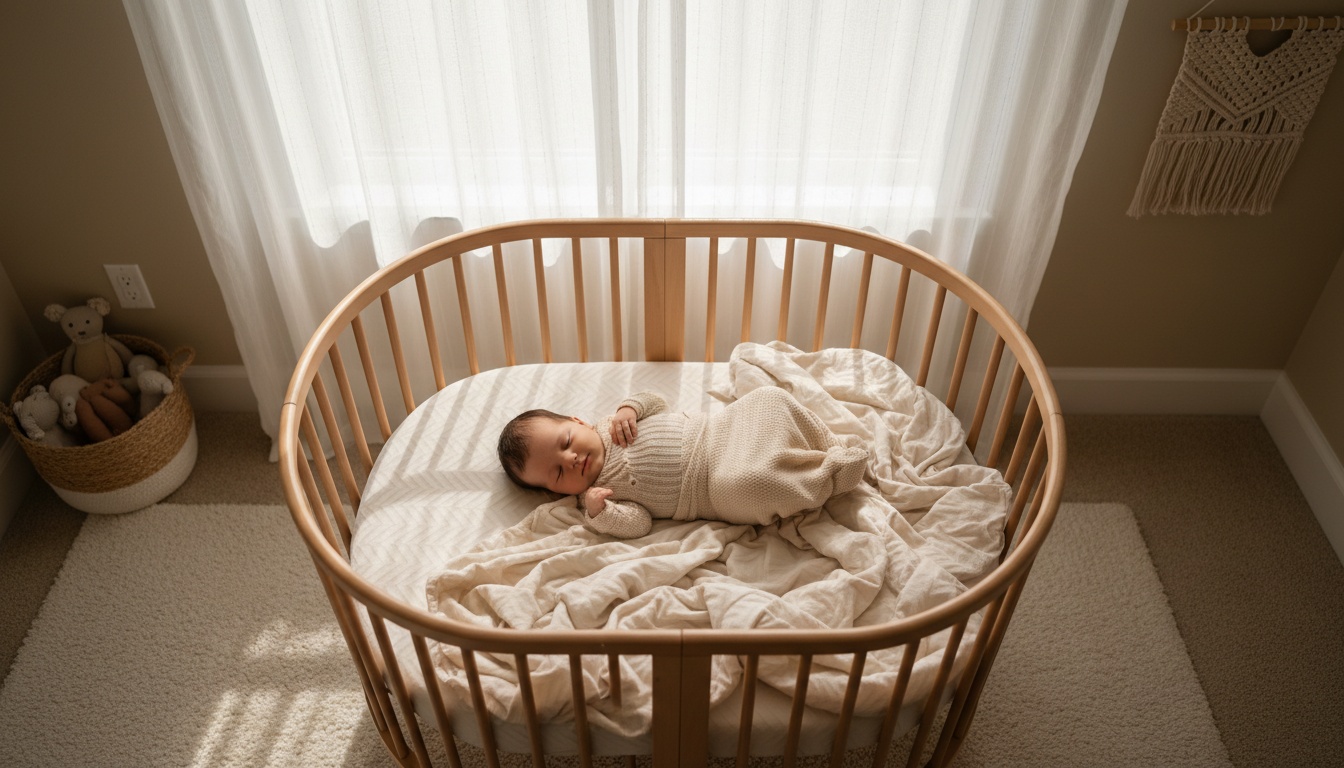
1. How Long Should an 8-Month-Old's Wake Windows Be?
The range is 2.5–3.5 hours — but the more useful question is why it varies, and what changes it for your specific baby. Windows should get progressively longer across the day, with the first window after morning wake being the shortest and the pre-bed window running longest.
Why does this matter so much at eight months specifically? Three things are happening at once. Sleep pressure — the biological drive to sleep, governed by adenosine buildup — is maturing. Circadian rhythm is consolidating. And a wave of developmental milestones is hitting the nervous system hard: crawling, pulling to stand, object permanence, early language.
A new eight-month-old often sits closer to 2.5 hours per window; a baby about to turn nine months may need the full 3.5 hours to build enough sleep pressure for a solid nap. The range that worked at six months probably doesn't fit anymore.
The other variable is nap schedule. Most 8-month-olds are somewhere on the 3-nap-to-2-nap transition spectrum, and which side of that line your baby is on changes the wake window math entirely.
---
2. Wake Window Ranges by Nap Schedule: 3-Nap vs. 2-Nap
Wake window duration isn't a single number you look up and apply. It's a function of how many naps your baby's taking, how long those naps run, and where you are in the month.
Wake Windows on a 3-Nap Schedule
Babies still on three naps typically need 2.5–3 hours between each sleep period. This is more common in younger 8-month-olds, babies who consistently take shorter naps (under 45 minutes), and babies on the lower end of the sleep-need spectrum.
Bedtime on a 3-nap day often lands in the 7–8 PM range for many families, though exact timing varies widely depending on your baby's wake time, nap lengths, and individual sleep needs. Many sleep experts suggest the last nap end by late afternoon to allow enough pre-bed wake window, but the right timing for your baby may differ. Push that third nap later and you're looking at a late bedtime, which many sleep experts link to more false start bedtimes, increased night wakings, and early morning wakes.
Three naps at eight months isn't a failure to transition. Some babies genuinely aren't ready, and forcing a 2-nap schedule before the nervous system can handle those longer awake windows just creates an overtired baby.
Wake Windows on a 2-Nap Schedule
This is where most 8-month-olds land. On two naps, wake windows stretch to 2.75–3.5 hours, with the pre-bed window running 3–3.5 hours. The last nap should ideally wrap up by late afternoon to protect that window, though exact timing varies depending on your baby's schedule and individual needs.
Bedtime on a 2-nap day typically falls somewhere in the 7–8 PM range for many families, though this varies widely. Parents often resist anything before 7:30 PM because it feels extreme — but the math works. If the last nap ends at 4:00 PM and the pre-bed window is 3 hours, 7:00 PM is exactly right.
No single nap should run longer than 2 hours. A nap that stretches past 2 hours eats into the sleep pressure needed for the next sleep period and tends to push bedtime later than you want.
Signs Your Baby Is Ready to Drop to 2 Naps
Your baby is ready to drop to two naps when you see consistent third-nap refusal for 1–2 weeks, the third nap pushing bedtime past 8 PM, or night wakings increasing despite good daytime sleep. Don't act on one bad day — look for the pattern.
Any one of those signals is worth noting. All three together means it's time.
But knowing which schedule your baby is on is only half the equation. The other half is what's actually happening inside those wake windows.
---
3. Why Your Baby's Wake Windows Don't Match the Chart
Five factors change the ideal wake window for a specific baby: developmental milestones, temperament, nap duration, night sleep quality, and illness or travel. The 2.5–3.5 hour range is a starting point — here's what actually moves the number.
Developmental milestones. Crawling, pulling to stand, pincer grasp, babbling with inflection — all of these are happening around eight months, and all of them increase mental load. During a big motor or cognitive leap, many babies temporarily need wake windows on the shorter end of the range. This is counterintuitive — tired babies should sleep more, right? The overstimulated nervous system hits a wall faster.
Beyond milestones, temperament matters. A high-needs or sensitive baby often maxes out at the lower end of the range. An easygoing baby may push toward 3.5 hours without showing classic sleep cues like eye-rubbing, yawning, staring into the middle distance, or arching their back. Neither is wrong — they're just different calibrations. (Temperament is the hardest factor to calibrate because there's no formula for it. You're reading your specific baby, not a chart.)
Nap length is another variable. A 45-minute nap builds less sleep pressure than a 90-minute nap. After a short nap, the following wake window may need to run a bit shorter. After a long nap, you can let the next window stretch a little.
The previous night matters too. After a rough night or an early morning wake before 6 AM, compressing the first wake window slightly can help prevent a full overtired spiral.
Finally, illness and travel both warrant shrinking wake windows across the board. A sick baby needs more sleep, not more stimulation. Return to normal windows within a few days of recovery — dragging the compressed schedule out longer can create new habits that are hard to undo.
Once you've calibrated the window length, what happens inside those windows directly affects how well your baby sleeps. Here's what actually moves the needle.
---
4. Sample Daily Schedules: 3-Nap, 2-Nap & Working Parent Examples
These aren't aspirational templates from a parenting book. They're built around how families actually operate.
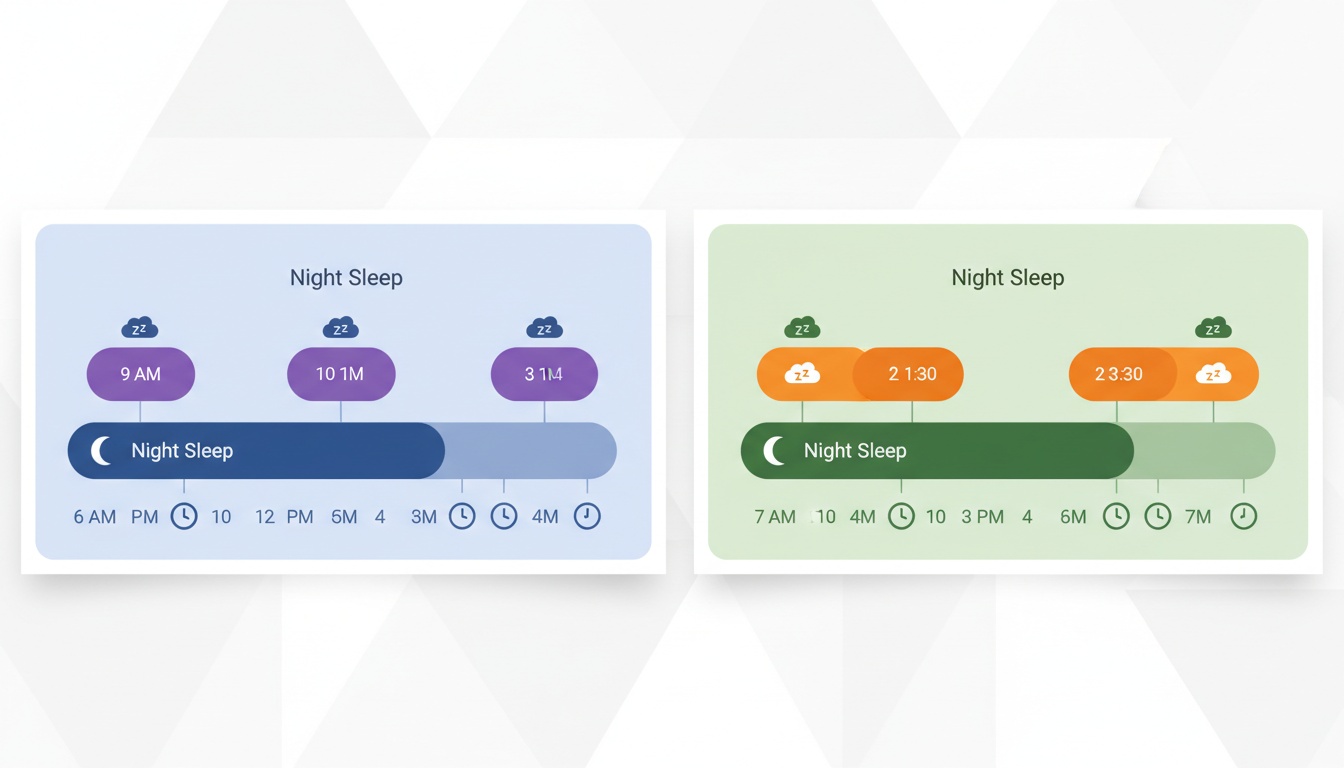
The graphic above shows these side by side — here's the full detail for each.
Classic 3-Nap Schedule (Flexible or Stay-at-Home)
Note: The wake time below is one common example. Adjust all times proportionally based on your baby's actual morning wake.
- 7:00 AM — Wake (example start time; adjust to your baby's schedule)
- 9:30 AM — Nap 1 (2.5-hour wake window)
- 11:00 AM — Wake from Nap 1 (assuming 90-minute nap)
- 2:00 PM — Nap 2 (3-hour wake window)
- 3:30 PM — Wake from Nap 2
- 5:30–6:00 PM — Nap 3 (short, 20–30 minutes max)
- 7:30–8:00 PM — Bed (roughly 1.5–2 hours after Nap 3 ends)
This only works if that third nap stays genuinely short. A third nap that runs 45 minutes pushes bedtime well past 8 PM.
2-Nap Schedule (Most Common at 8 Months)
Note: The wake time below is one common example. Adjust all times proportionally based on your baby's actual morning wake.
- 7:00 AM — Wake (example start time; adjust to your baby's schedule)
- 9:45 AM — Nap 1 (2.75-hour wake window)
- 11:15 AM — Wake from Nap 1
- 2:15 PM — Nap 2 (3-hour wake window)
- 3:45 PM — Wake from Nap 2
- 6:45–7:00 PM — Bed (3–3.25-hour pre-bed wake window)
Is 6:45 PM too early for an 8-month-old bedtime? Not on a 2-nap schedule with a 7 AM wake. Most 2-nap babies do well with a 7–8 PM bedtime, though exact timing varies by baby. On days when the last nap ends early or runs short, an earlier bedtime is appropriate.
Working Parent Schedule (Daycare Drop-Off by 8 AM)
Note: The wake time below reflects an earlier start common in working-parent households. Adjust all times based on your baby's actual schedule.
- 6:00 AM — Wake (example start time for early-rising families; adjust as needed)
- 8:30 AM — Nap 1 at daycare (2.5-hour wake window, compressed slightly)
- 10:00 AM — Wake from Nap 1
- 1:00–1:30 PM — Nap 2 at daycare
- 2:30–3:00 PM — Wake from Nap 2
- 5:30–6:00 PM — Bed (3–3.5-hour pre-bed wake window)
Daycare nap schedules rarely align with ideal wake windows. The honest fix: accept imperfect daytime sleep and protect bedtime. On days when daycare naps run short or late, a 15–30-minute catnap in the car or stroller can bridge the gap. Cap it at 30 minutes — let it run longer and you're pushing bedtime later than you want.
Second-Child or Disrupted-Routine Schedule
Older sibling pickup at 3 PM, soccer practice Tuesdays, unpredictable nap lengths — if this sounds like your week, you're not alone. The strategy: protect the first nap most aggressively. It sets the rhythm for the whole day.
Let the second nap float within a 30-minute window. If the second nap gets cut short by pickup or activity, move bedtime earlier by 20–30 minutes rather than trying to squeeze in a third nap.
---
5. Fixing Common Sleep Issues: Early Wakes, Short Naps & Refusal
Even with the right schedule, things go wrong. Here's how to identify what's actually happening.
How Bad Is the 8-Month Sleep Regression?
The 8–10 month sleep regression is driven by increased mobility, object permanence, and rising separation anxiety. Most parents rank it as the hardest regression of the first year — not because it's the most neurologically disruptive (the 4-month regression wins that), but because it hits after you finally had a schedule that worked.
You had a schedule. It was working. And then it wasn't. That's a different kind of hard.
Here's where parents go wrong: they assume the regression means wake windows need to change. Usually they don't. The regression is a neurological event, not a scheduling problem. Lengthening wake windows to tire baby out more almost always backfires. It creates an overtired baby who sleeps worse, not better.
Hold the schedule. Offer extra comfort during night wakings. The regression passes.
Early Morning Wakes (Before 6 AM)
If you're reading this at 5 AM, I'm sorry — and also, this is fixable.
Knowing the exact time your baby woke — not your best guess from when you stumbled in — is the first data point you need. A spare iPhone set up with BabyRadar's audio analytics gives you that timestamp automatically.
One common cause of early wakes is a pre-bed wake window that's too short. Not enough sleep pressure builds before bedtime, so the baby completes a sleep cycle around 5 AM and can't link to another one. The fix: gradually extend the pre-bed wake window by small increments every few days until early morning wakes resolve. Don't jump 45 minutes at once — that creates overtiredness.
Short Naps (Under 45 Minutes)
Short naps have two causes with opposite fixes: if your baby wakes happy and chatty, the preceding wake window was too short — extend it by 10–15 minutes. If your baby wakes fussy and still tired, they were overtired — shorten the preceding wake window instead.
Baby wakes happy? Chatty, ready to pull everything off the shelf? That's undertired. Baby wakes fussy, eye-rubbing, clearly still tired? That's an overtired baby who couldn't link sleep cycles because they went down too late. Shorten the preceding wake window.
Wakes happy vs. wakes fussy. That's the key distinction.
Nap Refusal
Third-nap refusal at eight months is a signs your baby is ready to transition to two naps signal. It means the baby's probably ready to move to two naps. Don't fight it for more than 1–2 weeks.
First or second nap refusal is different. That's almost always a wake window that's too short — the baby isn't tired enough to sleep. Push the wake window out by 15 minutes and try again.
When to Talk to Your Pediatrician
If your baby's wake windows are consistently shorter than 2 hours, sleep issues persist beyond 2–3 weeks of schedule adjustments, or you're seeing signs of pain (arching, excessive crying at sleep onset), talk to your pediatrician. Reflux, food sensitivities, and ear infections all disrupt sleep in ways that schedule changes alone won't fix.
---
6. Developmental Activities for Awake Time
Wake windows aren't just time to kill before the next nap. They're the developmental engine of your baby's day. What happens during awake time directly affects sleep quality.
Tummy time and gross motor play support the crawling and pulling-to-stand milestones that are driving the 8-month regression. A baby who's had good physical output during wake windows tends to build sleep pressure more effectively.
Object permanence games — peek-a-boo, hiding a toy under a blanket and watching the baby find it — are directly aligned with the cognitive leap happening right now. Separation anxiety commonly rises between 8 and 10 months as object permanence develops, according to the American Academy of Pediatrics. These games actually help the nervous system process that shift.
Feed at the start of each wake window, not the end. This keeps baby alert for play and avoids a feed-to-sleep association at nap time. It also helps you distinguish hunger cues from tired cues — the number one reason parents accidentally extend wake windows too long. Aim to offer breast or bottle within 30 minutes of waking. For breastfed babies, feeding at wake-up also helps regulate supply — milk production responds to demand, and a consistent wake-window rhythm creates consistent demand. Formula-fed babies have a bit more flexibility on timing. But the principle holds either way: feeding at the start of the window keeps the end of the window free of hunger cues that can be mistaken for tired cues.
Morning light in the first wake window. Even 10 minutes outside helps anchor the circadian rhythm. This is one of the most direct levers for reducing early morning wakes — more effective than most schedule adjustments alone.
Wind-down routine in the last 15–20 minutes. Dim the lights, shift to quiet play. Run the same pre-nap cues every time. Consistency here is what makes any pre-nap routine actually work — the nervous system starts anticipating sleep before the baby even hits the crib. This matters whether you're doing formal sleep training or not: the wind-down signals are the same either way.
Wake-window tracking apps. Tools like Huckleberry use logged nap and wake data to suggest age-appropriate wake windows in real time. They won't replace reading your baby's sleep cues — the yawning, the staring, the ear-pulling — but they're useful for parents who want a data layer on top of their observations, especially during the 3-to-2 nap transition when windows are shifting week to week. BabyRadar is a wellness audio analytics tool: sound event alerts and snapshots let you log the exact moment your baby wakes, which makes it much easier to spot whether a 5 AM wake is a pattern or a fluke.
For working parents: share these activity types with daycare providers. Outdoor time in the morning, active play mid-window, and a quiet wind-down before nap aren't hard to implement — but daycare staff won't do it automatically unless you ask.
---
7. Adjusting Wake Windows During Transitions and Disruptions
Nap transition (3→2). Don't drop the third nap cold turkey. Extend wake windows gradually and watch how the baby responds. During transitioning from three to two naps, a 20-minute catnap in the car or stroller can bridge the gap on hard days. Cap it at 20 minutes and time it carefully so it doesn't push bedtime late.
Travel and time zones. Prioritize the sleep environment — a dark room and white noise: prioritize these over perfect timing. An imperfect schedule in a good sleep environment beats a perfect schedule in a bright, noisy hotel room.
Illness. A sick baby needs more sleep. Compress wake windows across the board and return to normal once recovery is solid — dragging the compressed schedule out longer than necessary can create new habits. For illness during travel, the same principles apply.
Growth spurts. Temporary increases in sleep need are normal. Follow the baby's cues rather than the clock for a few days, then return to the age-appropriate schedule. Growth spurts at eight months often resolve within a few days, though duration varies by baby — if disruption extends well beyond a week, it may be worth considering whether a regression or schedule issue is also at play.
---
8. Key Takeaways
- 2.5–3.5 hour windows — most 8-month-olds need wake windows of 2.5–3.5 hours, with the pre-bed window running longest at 3–3.5 hours
- Progressive windows — wake windows get longer across the day; the first window is always the shortest
- 2-nap transition — most babies are on two naps by eight months; the last nap should ideally end by late afternoon to protect the pre-bed wake window, though exact timing varies by baby
- Total sleep — typically around 13–14 hours daily, often 10–12 hours overnight and 2.5–3.5 hours of daytime sleep across two or three naps; exact amounts vary by baby
- No single nap should exceed 2 hours — it disrupts sleep pressure for the next sleep period
- Short naps — opposite fixes depending on whether baby wakes happy (undertired: extend window) or fussy (overtired: shorten window)
- 8-month sleep regression — the 8-month sleep regression is a neurological event; don't lengthen wake windows to compensate; hold the schedule
- Feed at the start of wake windows, get outdoor light in the morning, and run a consistent wind-down in the last 15–20 minutes before each nap
- For a full picture of how wake windows shift month by month, see our sleep schedule by age guide
Once the wake windows are dialed in, the next challenge is knowing precisely when your baby wakes — especially during naps when you're not in the room. Many parents use a spare iPhone with BabyRadar's audio analytics to catch those moments without hovering. One less thing to guess about when you're already tracking multiple windows a day.
Sources: Taking Cara Babies, "8-Month-Old Sleep Schedule," takingcarababies.com; American Academy of Pediatrics, "Healthy Sleep Habits," healthychildren.org.